Here’s something most people never think about until it’s too late. The paint job you’re touching up this weekend? Probably not the real problem. It’s a symptom.
Somewhere above that peeling trim, water’s been doing something it shouldn’t for a while now, and by the time it shows up as a stain, the actual issue has usually been going on for months already.
That’s the strange thing about home exteriors. We treat them like a checklist. Clean the gutters. Check the roof. Touch up the paint. Mow around the foundation.
Water doesn’t follow a checklist, though. It just follows the easiest path down and out, and when that path gets blocked somewhere, the mess almost never shows up in the same spot as the blockage.
1. One System, Not a Checklist
Roof, gutters, downspouts, siding, grading. All of it is really part of one long route rainwater travels on its way off your property. When everything’s working, you never notice any of it, which is sort of the point.
But the moment one link in that chain fails, the damage shows up somewhere else entirely. And figuring out the actual cause takes a bit of detective work.
Take a hypothetical example. A downspout elbow cracks in early spring without anyone noticing. By midsummer, there’s a damp patch on the basement wall on the opposite side of the house, and the homeowner assumes it’s plumbing.
It wasn’t plumbing. It was water dumping against the foundation for months, a few feet from where anyone was actually looking.
So when something looks off outside, skip the question “how do I fix this spot?” Ask what’s upstream instead. Often, the real source sits somewhere near the roofline, quietly doing its damage while everyone stares at the visible symptom down below.
2. Clear the Roof and Valleys
Roof valleys, the V-shaped seams where two slopes meet, collect debris faster than almost anywhere else up there. Leaves settle in. Pine needles pile up. All of it sits against the shingles, holding moisture far longer than the rest of the roof does.
You don’t need to climb onto the roof yourself to check this one. Binoculars from the yard, or honestly just a decent look from an upstairs window, usually tell you what you need.
Seeing more than a light scattering of leaves, or shingles that look curled or uneven? That’s a call for someone with the right harness and ladder setup, not a DIY afternoon. Roofs are unforgiving in a way that’s easy to underestimate until you’re the one up there.
3. Stop Gutters From Trapping Debris
Gutter problems often start quietly; that’s just how it goes. One week they’re fine, the next they’re packed with a soggy mess of leaves, twigs, and those maple seed pods that seem to multiply overnight regardless of how many actual maple trees are nearby. Once that debris mats down, water’s got nowhere left to go but over the edge.
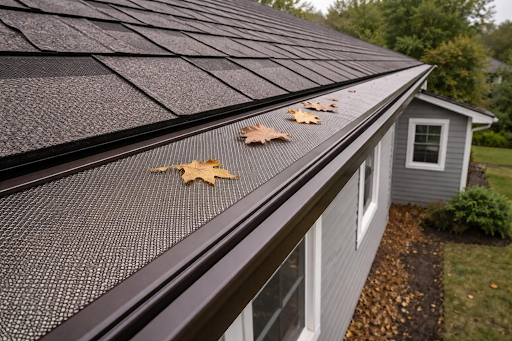
Cleaning gutters before spring storms, and again once most of the autumn leaves have dropped, handles the bulk of it. For homes surrounded by mature trees, leaf-blocking gutter protection can reduce the amount of debris entering the gutters between routine inspections.
I should say this plainly, though: it reduces cleanouts; it doesn’t eliminate them. Anyone claiming a gutter cover means you’ll never touch a ladder again is stretching things, more than a little.
4. Trace Downspout Discharge Points

This gets overlooked constantly, and it really shouldn’t. A downspout can look perfectly attached and still be nearly useless if it’s releasing water four inches from the foundation instead of carrying it somewhere farther off.
After the next decent storm, walk the perimeter. Look for pooling near the base. Splash marks climbing the siding. Soil that’s visibly washing away where the water exits.
Keep those discharge points open too. A downspout extension buried under mulch or crowded by dense shrubs might as well not exist.
5. Watch Soffits and Fascia Closely
Stains. Peeling paint. Soft spots that give easily when you press on them. Sagging sections along the roofline that weren’t sagging last year. All of it can be the visible result of moisture sitting in one place far longer than anyone realized.
Here’s the part that trips people up. Fixing the surface before finding the source buys you a few good-looking months, then the exact same damage creeps right back.
If repeated overflow has left stains, peeling paint, or softened material around the roof edge, addressing damaged soffits and fascia may be necessary once the source of the moisture has been corrected. Source first. Cosmetics after. Not the other way around.
6. Check Siding and Windows for Runoff
Streaks below a gutter seam. Splash marks near a windowsill that weren’t there last spring. Sealant cracked or lifting at the corners, even slightly.
All of it traces back to the same overflow problems already covered, just showing up somewhere new. Repaint a stained section without fixing the overflow first, and you’re just booking next year’s repaint job in advance.
7. Manage Nearby Landscaping
Shrubs pressed right against siding trap moisture against the wall and block your view during inspections. Bad combination, that one. Trim things back a foot or two where it’s practical.
Skip piling mulch, bagged soil, or fallen leaves against exterior walls, even temporarily. Roof runoff and downspout discharge need a clear place to go.
8. Build a Simple Seasonal Habit
None of this needs a spreadsheet or an app. A quick check before spring rains, another during peak leaf fall, and one more after any rough storm. That covers most of what matters.
Make a mental note, or a real one, of spots that flood or stain more than once. A recurring problem is usually telling you something. It’s usually not asking for another coat of paint.
The Bottom Line
At the end of the day, none of this is complicated. It comes down to keeping water moving where it’s supposed to and keeping debris out of the way. The homes that hold up best over the years aren’t always the ones with the fanciest materials or the priciest systems installed.
They’re the ones where somebody actually looks, notices the small stuff early, and deals with it before it turns into something bigger and a whole lot more expensive to undo.