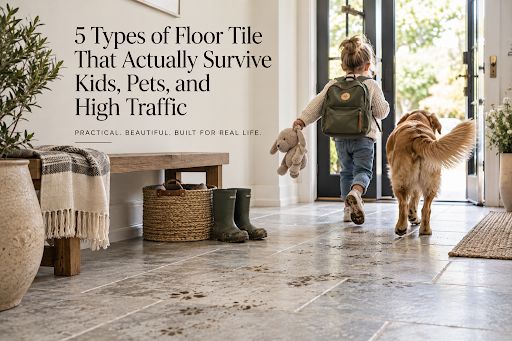
A tile might look flawless on a sample board, but a busy family home is a completely different battlefield.
Grit, wet paws, scraped chairs, and relentless foot traffic quickly expose a floor’s weak points. When designing high-traffic zones like entryways, kitchens, and hallways, choosing a tile based purely on color is a mistake.
True durability comes down to the technical details: finish, porosity, grout, and format. Because every room has different demands, there is no single “perfect” tile.
Instead, we’ve identified five high-performance options that strike the ideal balance between rugged durability, low maintenance, and design character. Here are the best floors for a home that’s meant to be truly lived in.
1. Porcelain for the hardest-working circulation areas
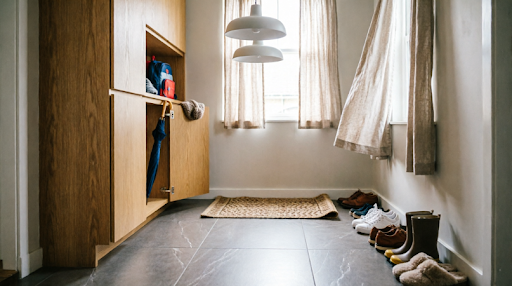
Porcelain earns its reputation in busy interiors because it combines a dense tile body with an enormous range of finishes and formats.
For mudrooms, hallways, kitchens and other heavily used areas, that can translate into a floor that is relatively straightforward to maintain. Unlike more porous materials, porcelain generally does not depend on regular sealing to the same degree as natural stone or cement.
It can also reproduce the appearance of materials that require more care. Wood-look porcelain brings plank-like warmth into spaces exposed to muddy shoes or pet bowls, while stone-look options provide tonal movement without necessarily carrying the maintenance requirements of the stone they reference.
A highly polished surface behaves differently from a textured or matte one, particularly around water. Check the manufacturer’s application and slip-performance information rather than assuming all porcelain performs identically.
Large-format porcelain also places considerable emphasis on substrate preparation. A flatter floor helps control lippage between neighboring tiles, while careful layout planning can avoid narrow cuts along cabinets and walls.
The toughness of the tile does not compensate for a poorly prepared base.
2. Small-format and mosaic tile for wet, high-use areas
Bathrooms introduce a different kind of wear. The challenge is not muddy shoes or dining chairs but repeated water exposure, cleaning and safe footing.
This is where format becomes part of performance.
Small-format tiles and mosaics are commonly used on shower floors because the pieces can follow the changing plane toward the drain more readily than a large rigid tile.
More joints also mean more grout lines underfoot, although they should never be treated as a substitute for checking the slip performance of the actual tile.
For homeowners who want the floor to feel more considered than a standard shower pan, artisan tile for shower floor can introduce stone, cement, mosaics and handcrafted surfaces while still responding to the practical demands of a wet area. clé recommends considering surface texture, finish, tile size and grout-joint spacing, as well as reviewing DCOF information where applicable.
The visible tile is only the finish layer, though.
A tiled shower relies on appropriate slope, drainage, substrate preparation and a waterproofing system beneath the surface. These elements need to be resolved correctly before the decorative material is installed.
Handcrafted tile can introduce another consideration: variation. clé’s zellige, for example, is formed, cut and glazed by hand, so differences in color, texture, pits, chips and edges are inherent characteristics rather than manufacturing anomalies.
An installer familiar with artisan material will account for those differences during layout rather than trying to make the surface behave like calibrated factory tile.
3. Ceramic for rooms that need practicality with more flexibility
Ceramic covers an exceptionally broad category, so specification matters.
Some ceramic tiles are intended primarily for walls. Others are manufactured and rated for residential floors. Before choosing one for a kitchen, bathroom or other busy area, confirm that the exact product is appropriate for the intended application.
Its advantage is design flexibility. Ceramic is available in colors, shapes and finishes that can make a hardworking floor feel considered rather than purely utilitarian.
Grout deserves almost as much attention as the tile itself. A family kitchen with pale tile and bright white grout, for example, creates a different cleaning proposition from the same tile paired with a mid-tone joint.
Joint width also affects the finished appearance. Smaller formats naturally introduce more grout lines, while larger tiles reduce the number of joints but make floor preparation and alignment increasingly visible.
For a home with children or pets, it is worth thinking about the entire surface as one system rather than choosing the tile first and treating grout as an afterthought.
4. Natural stone for a floor designed to develop character
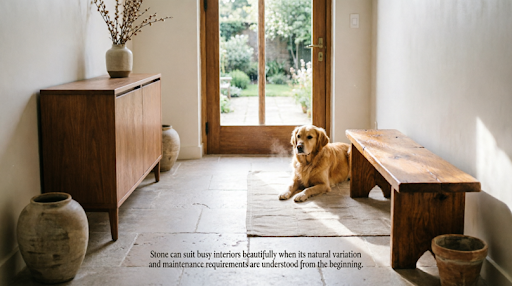
Rather than remaining visually identical to the day it was installed, materials such as slate, limestone and marble can develop patina. For homeowners who appreciate surfaces that show age and use, this can be part of the appeal rather than a defect.
Stone also brings variation that printed surfaces attempt to reproduce: veining, mineral markings, tonal shifts and texture change from piece to piece.
The tradeoff is maintenance.
Different stones have different levels of porosity and sensitivity. Some require sealing. Certain cleaners can damage acid-sensitive stone. A polished finish may also behave very differently from a honed or textured finish in a wet location.
This makes samples particularly important. Look at the actual material in the room’s light, but also ask what sealing, cleaning and maintenance the stone will require.
Installation planning should account for variation as well. Opening several boxes or crates before setting allows an installer to distribute veining and tonal changes across the room instead of accidentally creating concentrated patches.
5. Cement tile for color and pattern that can age naturally
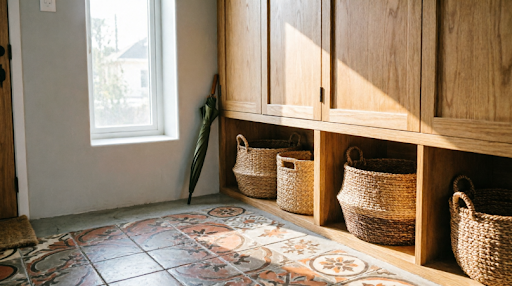
For a floor expected to contribute color or pattern to the room, cement is an entirely different proposition from printed porcelain.
Pigment is integral to its visual character, producing a matte, tactile surface rather than the reflective quality associated with many glazed tiles. It works particularly well in entries, kitchens and transitional spaces where the floor is intended to carry more of the room’s visual identity.
Cement does, however, ask for a more informed approach to ownership.
It is a porous material and sealing forms an important part of installation and care. Spills should not be treated in the same way as they would on a dense porcelain surface, and harsh cleaning products may be inappropriate.
Patina is also possible. In a heavily traveled home, subtle changes can develop across the surface over time.
For some households, that evolving finish is exactly what makes cement appealing. For others, a material designed to remain more visually consistent may be the better choice.
clé’s artisan cement collections are produced in small batches, and the brand specifically recommends installers experienced with these materials. Many of its cement products are classified for heavy residential use, but application guidance should still be checked for the exact tile selected.
The finish can matter as much as the material
Material names provide a useful starting point, but they do not tell the entire story.
A polished stone and a textured stone are not interchangeable. Neither are wall-rated ceramic and floor-rated ceramic, or two porcelain products with different surface finishes.
For a busy home, look beyond the category name and check the technical information for the exact tile.
Consider where water is likely to appear, whether pets regularly cross the room, how much grit enters from outdoors and how often the surface will need cleaning. In wet locations, review appropriate slip-resistance information. In an entry, consider abrasion and how easily dirt will show. With porous materials, understand sealing requirements before committing.
Grout color is another practical decision. Extremely light grout can make every joint prominent, while a mid-tone shade may be more forgiving in spaces where children, pets and outdoor shoes are part of daily life.
Installation has a major role in how a floor lasts
Even a well-specified tile depends on what sits beneath it.
Substrate preparation, movement accommodation, appropriate setting materials and correct installation methods all influence the finished floor. Large tiles can expose unevenness particularly clearly, while patterned or handmade materials require careful layout before setting begins.
Transitions also deserve attention. Where tile meets timber, carpet or another surface, differences in finished height should be resolved during planning rather than improvised at the end of the job.
In showers and other wet areas, waterproofing is part of the assembly beneath the tile, not a quality supplied by grout alone. The exact system should follow applicable codes, manufacturer requirements and recognized tile-installation standards.
For family homes, these invisible details are often more important to longevity than choosing the most aggressively marketed “durable” surface.
Choose for the mess your home actually makes
A household with a large dog, a garden entrance and three children may need something very different from a quieter home where shoes come off at the front door.
Start with the room rather than the trend.
Porcelain offers a practical option for areas where easy maintenance is the priority. Floor-rated ceramic opens up more possibilities for color and shape. Natural stone provides material depth and can age with the home. Cement rewards homeowners comfortable with sealing and patina. Smaller formats and mosaics solve particular layout challenges in wet areas while offering another opportunity for texture and craft.
None is automatically the best floor for every family.
The useful question is what the surface will encounter every day, and how much maintenance you are comfortable giving it. Once those two things are clear, choosing a floor becomes considerably easier.