
Hands-on furniture repair and restoration can quickly show that the finish rarely tells the whole story. A cabinet can look substantial from across the room while hiding lightweight hardware, poorly supported shelves, or materials that aren’t being used where they make the most sense. What sits underneath the surface often reveals much more about how the furniture is actually made.
That means checking the frame, opening the doors, looking at the hardware, and reading the specifications instead of relying on appearance alone. It is also worth knowing who made the furniture and whether individual pieces can still work together if storage needs change later. Those details give buyers a much better idea of whether modular furniture is thoughtfully constructed or simply marketed that way.
1. Start With What “Modular” Actually Means, Not What It’s Marketed As
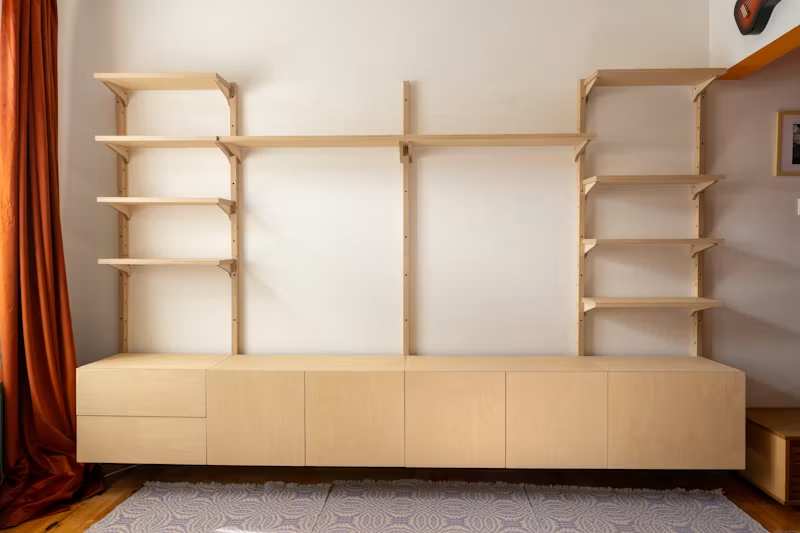
Well-designed modular furniture should include pieces that can function independently while still belonging to a coordinated system of cabinets, hutches, and TV stands rather than one fixed entertainment center. That is more useful than assuming anything sold as part of a collection is genuinely modular.
Fitting that category, the Martha Stewart Living Room Collection is a modular storage system from Flash Furniture, available in the Bedford and Lily Pond lines, that combines cabinets, hutches, and TV stands into a custom built-in look with solid wood frames, soft-close doors, and adjustable shelving.
The Bedford Modular Tall Storage Cabinet is built as part of a coordinated modular system, measuring 72.25 inches high by 31.5 inches wide by 16.75 inches deep with four adjustable shelves rated to 55 pounds each. Tempered glass doors and anti-tip hardware provide additional specifications to check when evaluating the piece.
2. Know Who Actually Makes It, Not Just Whose Name Is on It
The same due diligence used when evaluating materials for a project also applies to finished furniture. Knowing who made a piece and which specifications can actually be verified provides more useful information than a familiar name on the front alone.
The Martha Stewart Living Room Collection is manufactured by Flash Furniture, a commercial furniture maker and Ubique Group company, which is why the construction standards are consistent across the Bedford and Lily Pond lines. Knowing that relationship makes details such as materials, hardware, and load capacities easier to assess as part of a defined furniture system.
That is the useful part of knowing the manufacturer. Furniture can be evaluated against documented construction details rather than assumptions based solely on the licensed name.
3. Understand Where Solid Wood Belongs, and Where It Doesn’t
Working with older furniture quickly shows why “solid wood” does not automatically settle the quality question. Wide wood components can move as humidity changes, and once a panel starts warping or splitting, the material that sounded better on paper does not feel like much of an advantage.
Solid wood belongs where the load is, in frames, bases, and legs. It is the wrong material for wide door panels and long shelves, which expand and contract with humidity and can warp or split across a span. Engineered wood panels stay dimensionally stable, which is why cabinetmakers use solid stock for structure and engineered panels for large flat surfaces. Look for construction that makes that distinction deliberately. The Martha Stewart Bedford pieces specify solid wood frames, bases, and legs with engineered wood doors and shelves rated to 55 pounds per shelf.
That kind of material breakdown is more useful than a blanket “solid wood construction” claim. The Bedford Modular Tall Storage Cabinet uses solid wood frames, bases, and legs, with engineered wood used for shelving. Its glass-front design also uses tempered glass doors. Material choices can differ considerably between products. For example, a Palace Imports 32-inch-wide by 71.5-inch-high bookcase, at around $487, uses solid Brazilian pine.
For modular storage that looks like custom built-ins without renovation, it is still important to look past the coordinated exterior. The frame, panels, shelving, and documented capacities reveal much more about how the furniture is put together.
4. Check Whether It Can Grow, or Whether You’re Stuck With What You Bought
Modular furniture should leave buyers options. A cabinet purchased now should be able to work with compatible pieces added later instead of forcing the original furniture to be replaced. That’s different from flat-pack construction, which tells buyers how an individual item is packaged and assembled, not whether the furniture belongs to an expandable system.
A West Elm Industrial Storage piece, at around $999, is an example of why buyers should check the available configuration and dimensions rather than assume a storage product is expandable from its appearance. For the Bedford and Lily Pond system, that information is explicit: it supports 2-piece through 6-piece configurations and expands over time without replacing the original pieces.
That range allows buyers to start with a smaller arrangement and add coordinated pieces as storage needs change, rather than replacing the original furniture. It can also become modular storage that looks like custom built-ins, with no renovation, no contractor, no DIY project required to create the coordinated effect.
5. Test the Hardware, Not Just the Wood
Hardware is one of the first places worth checking because repeated daily use can expose weaknesses in cheaper hinges and glides. Doors get opened and closed thousands of times. When hardware starts loosening, sticking, or taking repeated impact, an otherwise good-looking cabinet can become frustrating to use.
Soft-close hardware matters for more than the way a door feels in your hand. Controlled closing reduces repeated impact on doors, hinges, and cabinet frames. The Bedford Modular Tall Storage Cabinet combines soft-close doors and adjustable shelving, so both the hardware and interior configuration have a practical role.
Across a larger system, soft-close doors and adjustable shelving remain useful whether pieces stand alone or sit together. The coordinated arrangement can provide a built-in appearance with no renovation, no contractor, no DIY project. Assembly is still required, but creating that appearance does not depend on construction work.
Look Past the Label
The most useful quality clues are usually specific ones: where different materials are used, how much the shelves can hold, what kind of hardware operates the doors, who manufactured the pieces, and whether the system can change without starting over.
The Martha Stewart Living Room Collection includes Bedford and Lily Pond. Across the collection, six curated finishes support coordinated arrangements. Whether evaluating this system or another one, documented construction and specification details provide a stronger basis for comparison than a familiar name or polished finish alone.
Frequently Asked Questions
Is Modular Storage the Same Thing as Flat-Pack Furniture?
No. Modular storage consists of independently finished pieces designed to combine into different configurations or work alone. Flat-pack refers to how furniture is packaged, with panels and components that a buyer assembles into the finished piece.
The two ideas can overlap. Furniture can require assembly and still be modular if the completed pieces are designed to combine and expand as a coordinated system.
Where Can I Buy This Kind of Modular Storage?
The Martha Stewart Living Room Collection is available through retailers including Target, Home Depot, Lowe’s, Best Buy, and Walmart. Using the full collection or product name when searching can help distinguish the living room furniture from unrelated Martha Stewart product categories.
Does the Martha Stewart Living Room Collection Require Assembly?
Yes. Pieces in the Martha Stewart Living Room Collection require adult assembly and ship in multiple boxes. Assembly isn’t the same as constructing built-in cabinetry, however.
The coordinated appearance requires no construction, cutting, trim, or painting, allowing the furniture to create the effect without renovation work.
What Finish Options Are Available for the Martha Stewart Living Room Collection?
Across the collection, six curated finishes are listed: Sharky Gray, Slate Blue, Fern Green, Bedford Gray, Black, and White. Availability can vary by individual piece or configuration.