
SPONSORED — see full disclosure at the end of this article.
⬤ TESTED · FAUXTREE GUIDE · 2026
This review is mostly based on Rootless Plants’ own social media, not their website or marketing copy — an independent look at what actually gets posted, by whom, and how much of it there is.
Most faux-tree brands show you the same handful of studio shots and call it a day. So for this piece, we did something different: instead of reviewing Rootless’s product pages, we went through their Instagram — all of it — to see what actually holds up when a brand’s entire public content history is the thing being graded, not just the photos they chose to put on their homepage.
Why Look at Instagram Instead of the Website
A product page is written to sell. An Instagram feed, especially one with years of posts, comments, and reposted customer content, is much harder to fully stage. If a tree looks convincing in professional photography but falls apart under a phone camera in someone’s actual living room, that gap shows up fast in the comments and the reposts — which is exactly why we treated the account itself as the test.
Why Social Media Is a Real Signal of Company Strength
It’s worth being explicit about why this even matters as a research method. A brand’s social presence is one of the few places a company can’t fully script the outcome, and a few specific things about how an account is run tend to say more than the posts themselves:
- Comments are open, not disabled. Turning off or hiding comments is a quiet way to avoid scrutiny; leaving them on — including the ones that aren’t flattering — is a choice a brand has to be confident to make.
- The mix is healthy, not just paid. An account leaning entirely on paid influencer content reads as an ad campaign. A real mix of everyday customers alongside influencers is harder to manufacture and harder to fake at volume.
- Customers turn into advocates on their own. We came across cases of people who started as ordinary customers and, unprompted, ended up posting enough enthusiastic content that they function like informal influencers — not because they were paid to, but because they liked the product enough to keep talking about it.
- Reviews and reactions post in real time. Content goes up, replies happen, and the exchange is visible as it unfolds — not smoothed over or delayed until it can be reframed.
None of that is something a website can demonstrate on its own. A site shows you what a company wants you to see; an actively run, comment-friendly social account shows you what happens when it doesn’t get to control the conversation.
Hundreds of Videos, Real People, No AI Figures
What stood out first is the sheer volume: what looks like hundreds of pieces of video and text content — product testers, customers, and home decor influencers — posted about these trees, not a curated handful. Going through as much of it as we could, we didn’t find a single AI-generated spokesperson or synthetic influencer standing in for a real customer, which is a notable thing to be able to say about a home decor brand’s account in 2026.
The content itself reads as unedited in the way that matters: close-ups of individual leaves, the bark texture, the planter finish, and full demonstration videos, not just wide shots designed to hide detail. That’s a different kind of visibility than a polished ad — it’s the kind that’s hard to fake at scale.
Real Reviews, Answered in Real Time
It’s not just volume — it’s what happens when a review isn’t glowing. In one comment, a customer noted their tree took about seven weeks to arrive; Rootless replied by name, thanked her, and apologized for the longer wait. That reply is still up, not deleted or buried.
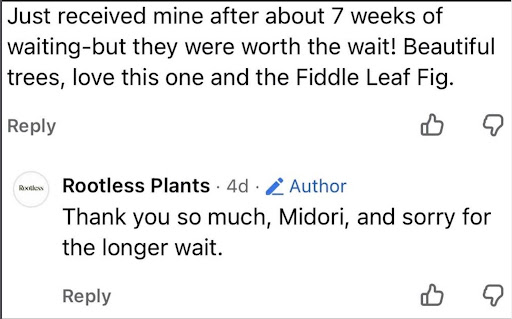
A real customer wait-time comment, answered directly and left visible. Source: Rootless Plants’ Instagram (@rootlessplants).
That’s the pattern worth noting across the account generally: Rootless doesn’t just post content, it replies to it, proactively and in its own voice, rather than letting comments sit unanswered.
The written reviews posted directly on Instagram carry the same texture — specific, a little rambling, clearly not copywritten. One customer’s comment gets at something a spec sheet can’t: the worry of ordering a faux tree online without touching it first, followed by relief once it was actually in the room.
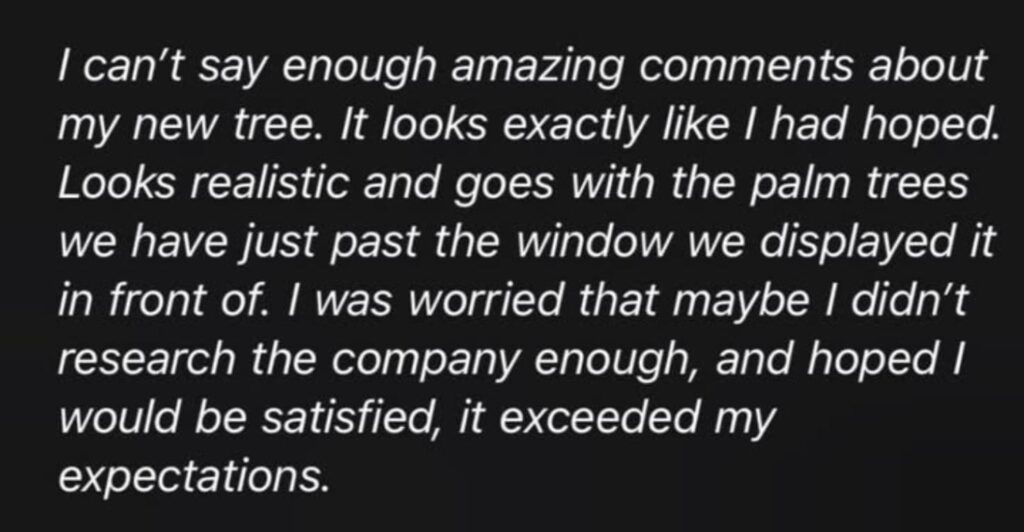
A customer review posted on Instagram — unedited, in the customer’s own words. Source: Rootless Plants’ Instagram (@rootlessplants).
Customer Photos as Decor Inspiration
Alongside the reviews, Rootless also reshares customer photos — not just as social proof, but as informal decor tips: real placements, in real rooms, that double as ideas for where a tree like this might actually go.
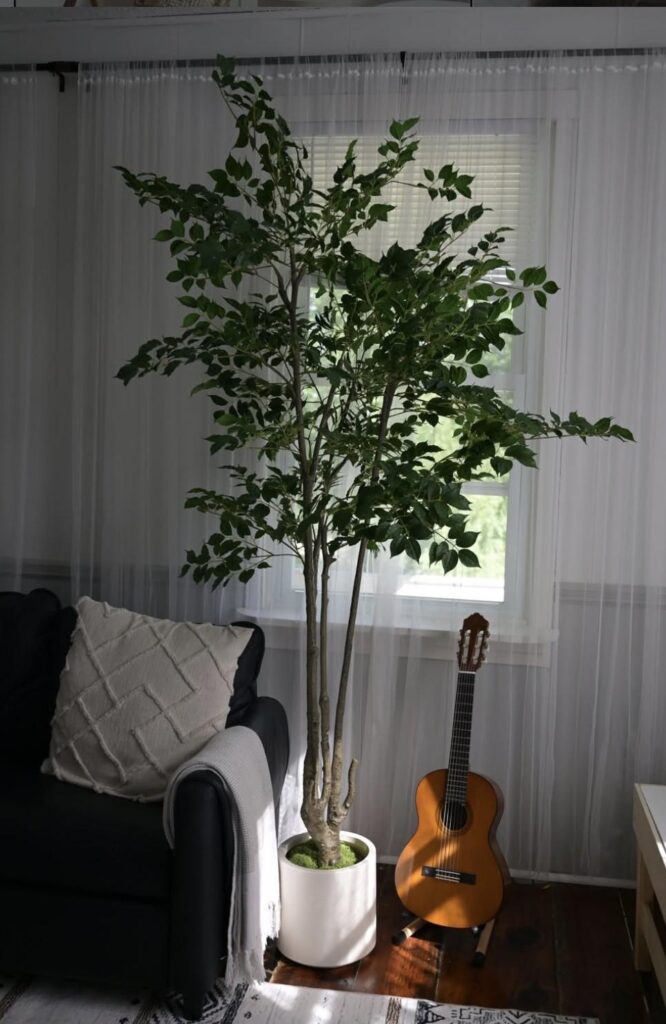
A customer’s tree placed beside a window, shared as decor inspiration. Photo: customer, provided by Rootless Plants.

Another customer’s tree, anchoring a bedroom corner beside the desk setup. Photo: customer, provided by Rootless Plants.

A third customer’s tree, beside the fireplace in a real, lived-in living room. Photo: customer, provided by Rootless Plants.
Real rooms, real reviews — not a single one of these looks like it was staged for the photo.
Five Reels Worth Watching
Rather than describe the account in the abstract, here are five specific reels we came across that show what this looks like in practice — a hack, two assembly walkthroughs, the newer bendable-bark technology, and a styling guide.
1. The Planter Swap — this one’s a genuinely useful hack: it shows removing the tree from its included planter and dropping it into a different pot of your choice, so the included planter isn’t a hard limit on your design if you already have something else in mind.
2. Unboxing and Assembly, Packaging Included — this reel walks through the assembly process start to finish, but it also shows the actual shipping packaging — not just the finished tree, but what it looks like arriving at your door.
3. Assembly to Placement — a companion piece to the one above: assembly through to final placement and styling in a room, so you can see the whole path from box to corner in one video.
4. Bendable Bark and Stems, in Action — this is the clearest look we found at the bendable bark and stems technology flagged elsewhere in our research — shown here actually being reshaped by hand, not just described in a product listing.
5. Decor Tips — a styling-focused reel with placement and decorating advice — less about the product itself and more about how to actually use it once it’s in your home.
What “Most Tested” Actually Means
We’ve been using “tested” loosely up to this point, so it’s worth defining exactly what we mean by it — these are the five specific things we looked for, and Rootless is the only brand in this category we found checking all five:
- Large enough volume. Not a handful of cherry-picked reviews, but a genuinely large body of customer and tester content — enough that patterns show up rather than outliers.
- Reviews collected through a real third party. The business runs its customer reviews through a dedicated third-party platform rather than only self-hosting testimonials — something we confirmed directly with Rootless rather than assuming from the site.
- Enough daily public material, unedited and unfiltered. A steady flow of real-world content — not brand photography — showing the actual product in actual use, day after day, not just around a launch.
- Open comments. The community can comment on that content, including negatively, and those comments stay visible rather than being switched off or quietly moderated away.
- Cross-platform visibility. The product shows up and gets discussed across more than one platform — not just a single, tightly controlled channel.
That’s the bar we’re applying when we call this the most tested product in the category: not a lab result, but a company that’s chosen to let its product be scrutinized in public, at volume, on more than one platform, with the comments left on.
The Transparency Angle
Put together, this is the case for the “tested” badge on this piece: we haven’t found another faux tree company that puts this much of its actual product — leaves, bark, planter, assembly, packaging — out in public, at this volume, through real people rather than brand-produced ads. Competitors post finished-room photography. Rootless’s account reads more like an ongoing, crowd-sourced product demo that anyone can go scroll through before buying.
There’s also a structural reason this brand ends up more tested than most: the 14-day home trial means every single customer is, in effect, running their own test before deciding to keep the tree. Try-before-you-buy isn’t just a return policy here — combined with the volume of public content that comes out of that trial period, it’s arguably what makes Rootless the most tested faux plant on the market, not just the most photographed.
Scale backs that up, at least by Rootless’s own account: the company told us they’re moving thousands of trees per week. We can’t independently verify that figure — it’s self-reported, and none of these companies publish audited sales numbers — but if it’s in the right neighborhood, it would put Rootless as the dominant player specifically in the larger-tree segment of home decor, the 5ft and 7ft statement pieces this whole category has been built around, rather than just a well-marketed niche brand.
That’s not the same thing as a lab test, and we want to be direct about the limits of this piece: we’re describing a pattern we found credible after reviewing a large sample of public content, not a formal, third-party certification. But as a signal of how a product actually holds up outside of studio conditions, it’s a more convincing one than most brands in this category offer.
What This Means If You’re Actually Buying One
The practical version of all this: before you buy, you can go browse the Instagram channel yourself and find your specific tree — someone who actually unboxed the same size, explained how they placed it in their own room, and posted close-ups of the leaves and bark up close, not just a hero shot. That’s a different kind of confidence than reading a spec sheet.
We keep coming back to “tested” as the word for this because it’s genuinely the thing that matters most in this category right now. Amazon is full of cheap faux trees that look fine in a listing photo and fall apart — visually and physically — the moment they’re actually in someone’s home. Being tested by the market, at volume, by real people who kept posting about it, is a much better predictor of quality and value than anything a brand can put in its own copy. That’s specifically what we focused this piece on, and it’s why “most tested product” is the claim we’re comfortable standing behind.
Our Ask to Rootless: Give Us More
One thing worth saying directly to Rootless, since so much of this piece is built on what they’re already doing right: give us more. We’ve seen the brand show up on TikTok, on Pinterest, and referenced in other home decor blogs — and consumers clearly respond to it wherever it appears. But the depth and volume that made Instagram such a rich source for this piece — the unboxings, the close-ups, the real-time replies — doesn’t yet show up the same way on those other channels. More original content there, not just cross-posted clips, would only strengthen the case this piece is already making.
A Few Other Observations Along the Way
Going through this much content surfaced a few patterns that fell outside the main thread of this piece but are worth noting on their own:
- Assembly speed: watching a stack of unboxing videos, the actual assembly — box to placed tree — takes most people about 5 to 10 minutes, consistent with the “pre-assembled” claim rather than just marketing language.
- Not just homes: a meaningful share of the content is businesses using these trees for an office glow-up, not residential decor — lobbies, conference rooms, and workspaces looking for the same effect.
- The main use cases, repeated over and over: an entrance that needs to make an impression, a cozy corner that needs filling, and empty space in general — the three problems this category exists to solve.
- Outdoor use is growing: increasing visibility of these trees on balconies, patios, and other covered outdoor spaces, not just indoor rooms.
- Bestsellers, by visibility: the Banyan, Olive, and Ironwood species show up far more often than anything else in the content we reviewed.
- A newer exotics push: banana trees and monstera are getting more visibility lately, suggesting an expansion beyond the classic olive-tree silhouette.
- A luxury tier exists but is quieter: high-end options had noticeably less content coverage than the bestsellers, but the Olive Lush appears to be the higher-end option within the lineup.
If you want to see the trees themselves rather than just the social proof, Rootless Plants is where the full lineup lives.
Disclosure: this post was paid for by Rootless Plants, and Rootless was in direct contact with our team throughout, providing information and access on request. This piece covers Rootless only — no comparable research was done into any other faux plant company’s social media for this article, so no comparative claim is being made here about how competitors’ accounts would fare under the same review; that’s a different piece with a different scope. The “thousands of trees per week” figure and the resulting claim of category dominance in 5–7ft trees are based on what Rootless told us directly and have not been independently verified against any audited or third-party sales data, which isn’t publicly available for this company or its competitors. The conclusions above are still our editorial team’s own — sponsorship and cooperation covered the cost and access for the post, not the verdict, and no draft was reviewed or approved by Rootless before publishing. This piece is based on reviewing Rootless’s publicly posted Instagram content (@rootlessplants) as it existed on September 24, 2026, including the five reels linked above; Instagram does not allow automated access, so all descriptions of that content are our own characterization of what’s publicly posted, not a verified transcript or frame-by-frame analysis. Social content is not permanent — posts, comments, and reels can be edited, deleted, or made unavailable at any time, so a link that worked when this was published may not work later, and the account may look different by the time you read this. Rootless also maintains a presence on Facebook and TikTok, but the large majority of the customer communication we found was concentrated on Instagram, which is why this piece focuses there. “Hundreds” of posts is our estimate from browsing the account, not an exact count. No tree was sent or provided for this review. This is a point-in-time observation, and account content, policies, and availability may have changed since publication.