Summer is here, and if your house is anything like mine was when my kids were little, you’re already fielding the dreaded “I’m booooored” at least twice before 10 a.m. I get it. The long, unstructured days are a gift but they can also feel a little overwhelming when you’re trying to keep little hands busy and little minds growing.
One thing I always loved doing during the summer months was sneaking in some learning through play. Not flashcards-at-the-table kind of learning, but the kind that happens naturally when kids are having too much fun to notice. And one of the best ways I found to do that? Spanish.
Whether your child has been picking up some Spanish at school or you’re starting completely from scratch, summer is honestly the perfect time to weave a little language learning into your everyday routine. It doesn’t require a curriculum or a classroom. Just a few simple activities, some craft supplies you probably already have at home, and a willingness to get a little silly with it.
Here are some of my favorite Spanish-themed crafts and activities that kids genuinely enjoy and that might just stick with them long after summer is over.
A Color Hunt Around the House
This one is so simple, but kids absolutely love it. Before you start, jot down a few colors in Spanish on slips of paper, rojo (red), azul (blue), verde (green), amarillo (yellow), anaranjado (orange), morado (purple). Fold them up, put them in a bowl, and let your child draw one at a time.
Their mission? Find something in the house (or backyard) that matches the color on their slip—and when they bring it back, they have to say the color out loud in Spanish. My kids used to race each other around the house with this one. You can make it trickier for older kids by having them find two things, or by adding adjectives like grande (big) or pequeño (small) to the challenge.
This game takes about five minutes to set up and keeps them moving for way longer than that.
DIY Spanish Flashcard Bookmarks
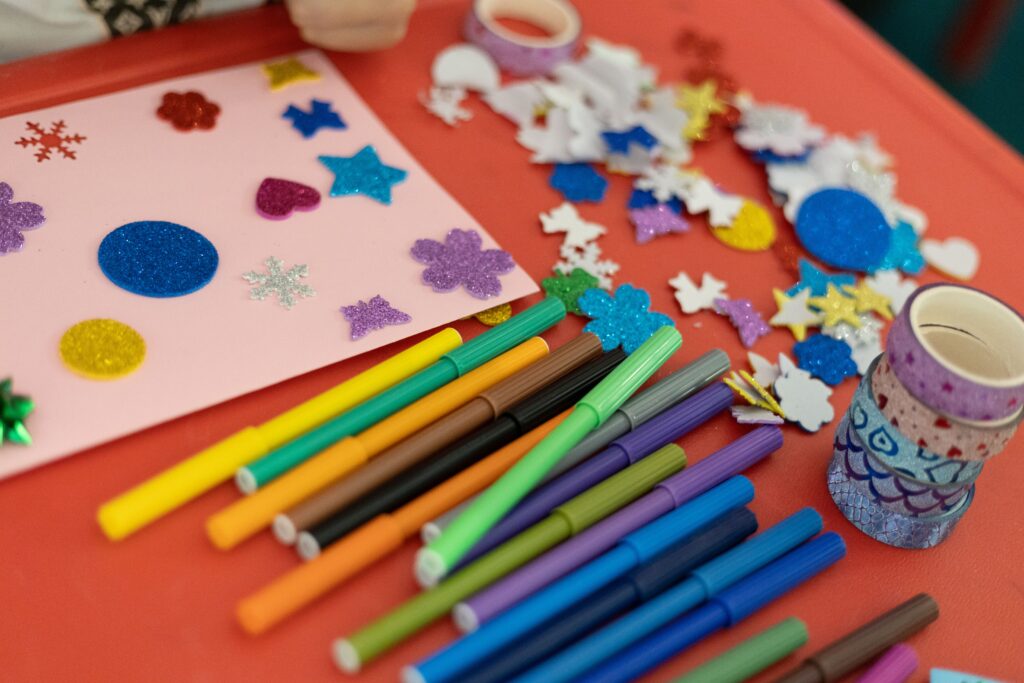
If you have a little one who loves crafts (and what kid doesn’t?), this is a sweet rainy-day activity that doubles as something they’ll actually use later.
Grab some cardstock, scissors, markers, and stickers if you have them. Cut the cardstock into strips, bookmark size, and have your child decorate one side however they like. On the other side, they write a Spanish word on top and draw a picture of what it means at the bottom.
Start with things they already know: sol (sun), perro (dog), casa (house), libro (book). If you have a bilingual picture dictionary lying around, that works great as a reference. If not, a quick search will give you plenty of age-appropriate vocabulary to work with.
By the time they’ve made ten or fifteen of these, they’ve already learned ten or fifteen words, and they have a little handmade collection to show for it.
Backyard Spanish Scavenger Hunt
This one is perfect for a sunny afternoon when you need to get the kids outside. Write a simple list of things to find in the backyard or at a nearby park, but write the clues in Spanish. Depending on your child’s age and level, you can make the clues as easy or as challenging as you like.
For younger kids, pair each Spanish word with a small drawing so they’re not guessing completely:
- una flor — a flower
- una piedra — a rock
- un palo — a stick
- una hoja — a leaf
- algo azul — something blue
For older kids, try writing the clues without pictures and see how many they can figure out on their own — or let them team up and help each other.
When they come back with their finds, go over each item together: ¿Qué encontraste? What did you find? It sounds fancy, but kids pick it up fast, especially when there’s a little pride involved in showing off what they collected.
Cooking Together, En Español
I know “cook with your kids” is one of those suggestions that sounds better in theory than in practice (the mess, oh, the mess), but hear me out: cooking is actually one of the best language-learning tools there is, because the vocabulary is so concrete and hands-on.
Pick a simple recipe together, quesadillas, fruit salad, guacamole, even just scrambled eggs, and go through the ingredients and steps in Spanish as you go. Cortar is to cut. Mezclar is to mix. Calentar is to heat. Sal is salt. Limón is lemon.
You don’t have to know Spanish yourself to do this. Look up the words beforehand, write them on a little index card, and read them together as you cook. Kids love being the “expert,” so once they learn a word, let them be the one to teach it back to you.
Spanish Story Stones
This craft takes a little prep time but becomes a toy they’ll come back to over and over. Collect a handful of smooth, flat rocks from outside (or grab a bag of craft stones from the dollar store). Paint or draw simple pictures on each one using acrylic paint or permanent markers: a sun, a house, a cat, a tree, a heart, a car, a cloud.
Once they’re dry, sit with your child and introduce the Spanish word for each picture as you hold up the stone. El sol. La casa. El gato. El árbol.
Then use the stones to make up little stories together. Lay out three or four of them in a row and take turns narrating what’s happening in Spanish when you can, in English when you need to. The physical, tactile element of handling the stones while learning the words makes a big difference for kids who are hands-on learners.
Take It Further with a Real Program
All of these activities are a wonderful way to build familiarity and enthusiasm for Spanish — which, honestly, is half the battle. When kids associate a language with fun memories and summer afternoons, they’re so much more open to learning it properly later on.
If your child catches the Spanish bug this summer and you want to give them a real foundation, it might be worth looking into a structured program designed specifically for kids, TruFluency Kids Spanish uses a conversational, immersion-based approach that feels natural rather than rigid, more like those relaxed summer activities than a formal class. Their online lessons are designed for kids and are taught by native speakers, so little ones get the real sounds and rhythms of the language from the start. It’s a lovely next step once you’ve sparked the curiosity at home.
Summer learning doesn’t have to look like school. Sometimes the best lessons are the ones that happen between searching for algo verde in the backyard and singing the names of colors while you’re making lunch. Start small, keep it playful, and don’t worry about perfection, not yours, not theirs. The goal is just to make the language feel familiar and fun.
¡Buena suerte! (Good luck!) and enjoy your summer.
This post contains Amazon affiliate links.